Pure Sine Wave vs Simulated Sine Wave UPS: Which Do You Need?
The waveform specification describes the AC output a UPS produces when it is running from its battery and inverter. Some models provide a sine wave that closely matches utility power. Others produce a stepped approximation commonly described as simulated sine wave.
What is simulated sine wave?
Simulated sine wave output approximates an AC sine wave using stepped voltage levels. It is common in many affordable standby and line-interactive UPS systems. For equipment that tolerates this waveform, it is a cost-effective way to provide battery backup.
CyberPower describes simulated sine wave as an approximated sine wave and notes that some newer high-efficiency equipment may not function properly with it. CyberPower simulated sine wave overview.
What is pure sine wave?
A pure sine-wave UPS produces battery output that more closely resembles normal utility AC. Pure sine-wave models are often chosen for active-PFC computer power supplies, workstations, higher-end gaming PCs, NAS systems, servers, audio equipment and other electronics where compatibility or electrical behavior matters.
Does every computer require pure sine wave?
No. Many computers work normally on simulated sine-wave UPS output, especially at moderate loads. The question is not whether simulated output is universally bad, but whether the specific power supply and load are known to tolerate it.
Pure sine wave reduces uncertainty. That is why it is often preferred when protecting expensive systems, active-PFC power supplies, home servers or equipment that you cannot easily test under battery operation.
Cost and capacity tradeoffs
Simulated-sine models usually cost less at a given VA rating. Pure-sine units often cost more, but they may also provide higher watt ratings, stronger management features or more business-oriented battery serviceability. Compare the entire model rather than treating waveform as the only decision.
A simple rule
| Situation | Waveform to investigate first |
|---|---|
| Router/modem and basic electronics | Simulated sine wave is often adequate |
| Basic home-office desktop | Either, depending on power supply compatibility |
| Gaming PC or workstation with active PFC | Pure sine wave is the safer starting point |
| NAS or home server | Pure sine wave is often preferred |
| Sensitive business/server equipment | Pure sine wave or online UPS |
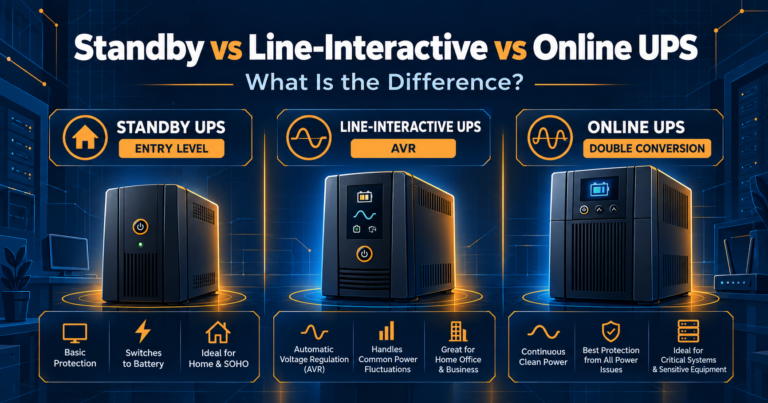
For topology as well as waveform, see Standby vs Line-Interactive vs Online UPS.
Research exact models: Browse the UPSIndex database or compare two UPS models side by side.
Bottom line
Simulated sine wave is economical and works for many ordinary loads. Pure sine wave costs more but provides broader compatibility and is a sensible default for higher-value computers, NAS systems, workstations and other equipment where battery-mode behavior matters.