VA vs Watts in a UPS: What Do the Ratings Actually Mean?
VA and watts are two different limits on a UPS, and both matter. VA measures apparent power while watts measure active power. A UPS can only support a connected load when that load stays within both ratings.
Why a 1500VA UPS is not automatically a 1500W UPS
Consumer UPS models commonly have a watt rating that is lower than the VA rating. For example, a 1500VA unit might support 900W or 1000W. The difference reflects power factor and the electrical design of the UPS.
A simple way to think about it is that VA describes the overall apparent electrical load, while watts describe the portion doing useful work. For UPS shopping, the watt number is usually the more intuitive ceiling for computers and electronics, but the VA limit still cannot be ignored.
Power factor connects the two ratings
Power factor is the ratio of active power to apparent power. If a UPS is rated 1500VA and 1000W, its output power factor based on those ratings is about 0.67. A 1500VA/900W model is about 0.60. Higher-end UPS designs may have higher output power factors and therefore deliver more usable watt capacity at the same VA rating.
ENERGY STAR defines power factor as the ratio of active power to apparent power in its UPS criteria. ENERGY STAR UPS criteria also distinguish UPS classes by rated output power and input dependency characteristics.
Use the lower limiting factor
Suppose your equipment draws 950W. A 1500VA/900W UPS is not large enough because the watt limit is exceeded. A 1500VA/1000W model may support the load electrically, but operating at 95 percent of its watt rating would still leave very little headroom and usually produce short runtime.
The practical target is not merely to stay below the printed maximum. Leave room for temporary load spikes, future equipment and more useful battery runtime.
Why two UPS models with the same VA can behave differently
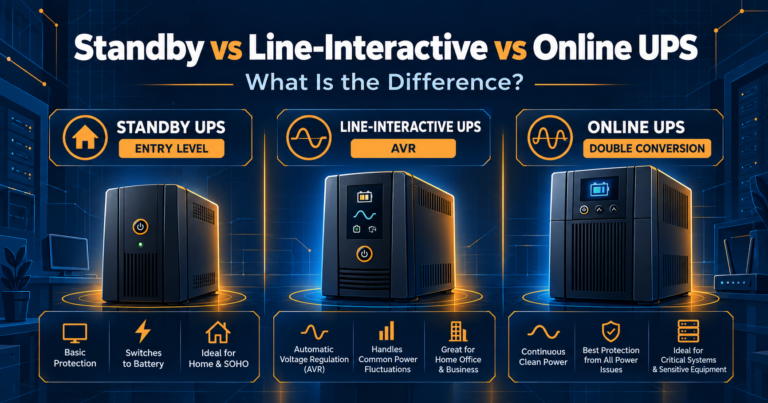
The VA number alone does not tell you watt capacity, battery size, runtime, waveform or topology. That is why two 1500VA models can be aimed at very different buyers. One may be a simulated-sine home-office unit while another may be a pure-sine rackmount model with network management.
How to size from watts
- Estimate or measure the normal watt draw of all equipment that must remain on battery power.
- Check the maximum watt rating of the UPS, not only VA.
- Leave reasonable headroom instead of sizing directly at the maximum.
- Review runtime at a load close to your expected use.
- Check waveform and topology if the protected equipment is sensitive or expensive.
For the full sizing process, read How Much UPS Capacity Do You Need?.
Research exact models: Browse the UPSIndex database or compare two UPS models side by side.
Bottom line
VA and watts are complementary ratings. Watts tell you how much active load the UPS can support, while VA tells you the apparent-power limit. A safe UPS choice must stay inside both limits and still leave enough headroom for runtime and future load growth.