
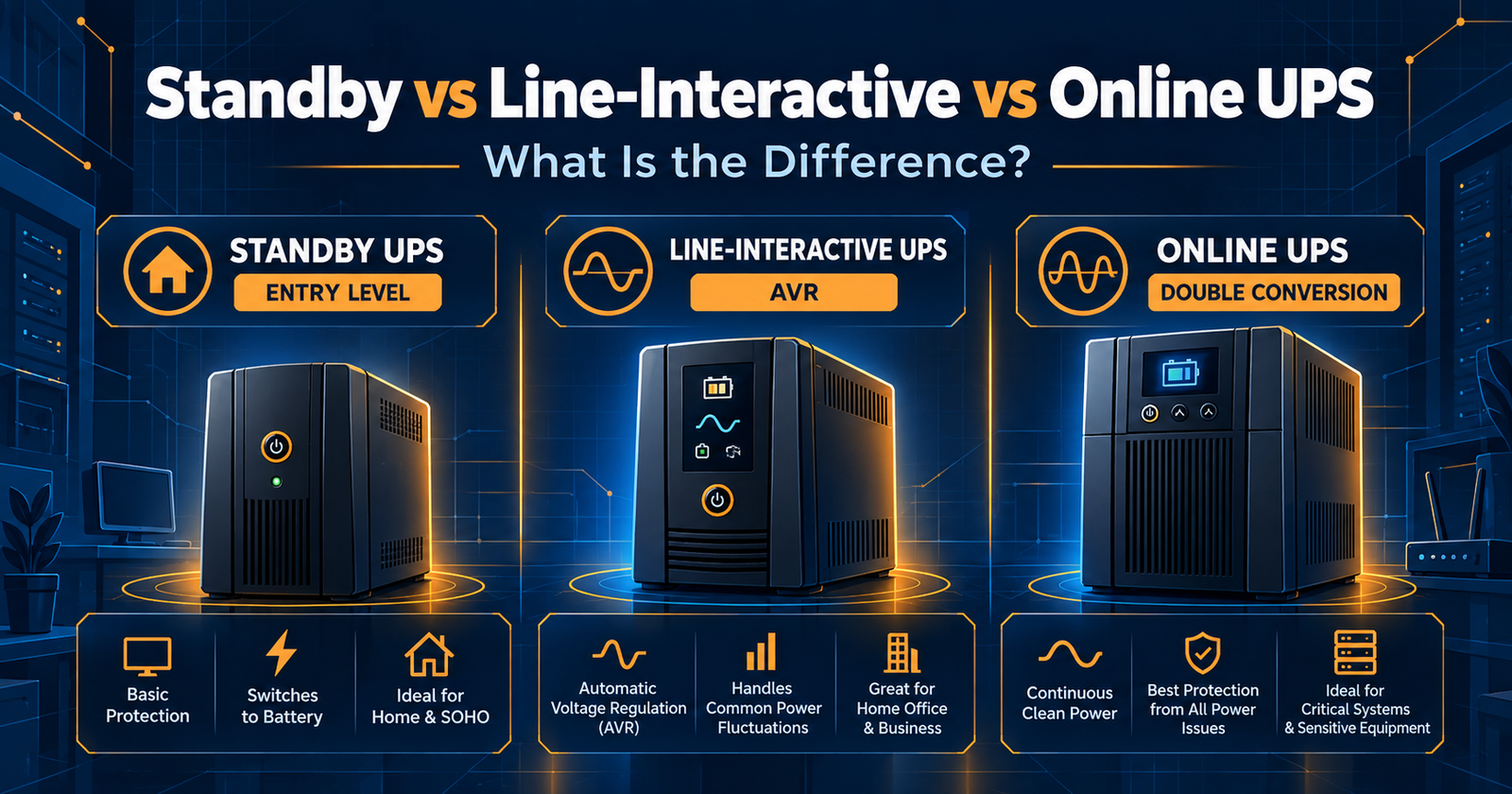
Standby vs Line-Interactive vs Online UPS: What Is the Difference?
Standby, line-interactive and online UPS systems all provide battery backup, but they handle normal utility power very differently. The topology affects voltage regulation, transfer behavior, efficiency, cost and the type of equipment the UPS is best suited to protect.
Standby UPS
A standby UPS, sometimes called offline UPS, normally allows utility power to feed the connected equipment directly. The battery and inverter wait until the input moves outside an acceptable range or fails. The UPS then transfers the load to battery power.
Standby models are common for routers, basic desktop computers and other lower-cost electronics. They are usually compact and efficient, but provide less power conditioning than line-interactive or online designs.
Line-interactive UPS
A line-interactive UPS adds automatic voltage regulation, usually through an autotransformer. AVR can correct many low-voltage or high-voltage conditions without switching to battery. That reduces unnecessary battery cycling and makes line-interactive models a common choice for home offices, gaming systems, NAS equipment, network gear and small servers.
CyberPower describes line-interactive AVR as a way to correct minor power fluctuations without switching to battery, which can extend battery life. CyberPower CP900AVR specifications are one current example.
Online or double-conversion UPS
An online UPS continuously converts incoming AC power to DC and then recreates AC output through the inverter. The connected load is therefore powered through the conversion system during normal operation rather than waiting for a transfer event.
This design offers stronger isolation from input disturbances and is common in more critical server, networking, medical and industrial applications. The tradeoffs are higher cost, more heat and typically lower efficiency than simpler designs, although modern systems can be quite efficient.
Side-by-side comparison
| Feature | Standby | Line Interactive | Online / Double Conversion |
|---|---|---|---|
| Normal power path | Utility feeds load directly | Utility feeds load with regulation | Load powered through conversion system |
| Voltage regulation | Limited | AVR commonly included | Continuous conversion |
| Transfer to battery | Yes | Yes | No transfer in normal double-conversion operation |
| Typical cost | Lowest | Middle | Highest |
| Common uses | Routers, basic PCs, small electronics | Home office, gaming, NAS, network, small server | Critical servers, sensitive equipment, higher-availability systems |
Which topology should you choose?
For a modem/router or basic home setup, standby may be enough. For most enthusiast and small-business situations, line-interactive is the practical middle ground because it combines battery backup with voltage regulation. Online UPS becomes more attractive when equipment sensitivity, uptime requirements or power quality justify the added cost and energy use.
ENERGY STAR categorizes UPS input dependency as VFD, VI and VFI, which broadly correspond to standby, line-interactive and online behavior. ENERGY STAR explains these categories.
Research exact models: Browse the UPSIndex database or compare two UPS models side by side.
Bottom line
Topology should match the consequences of a power problem. Standby is simple and economical, line-interactive is the most versatile choice for many homes and small offices, and online UPS is designed for more demanding protection requirements.