APC SMT1500C vs SMC1500C: Which Smart-UPS for a Server?
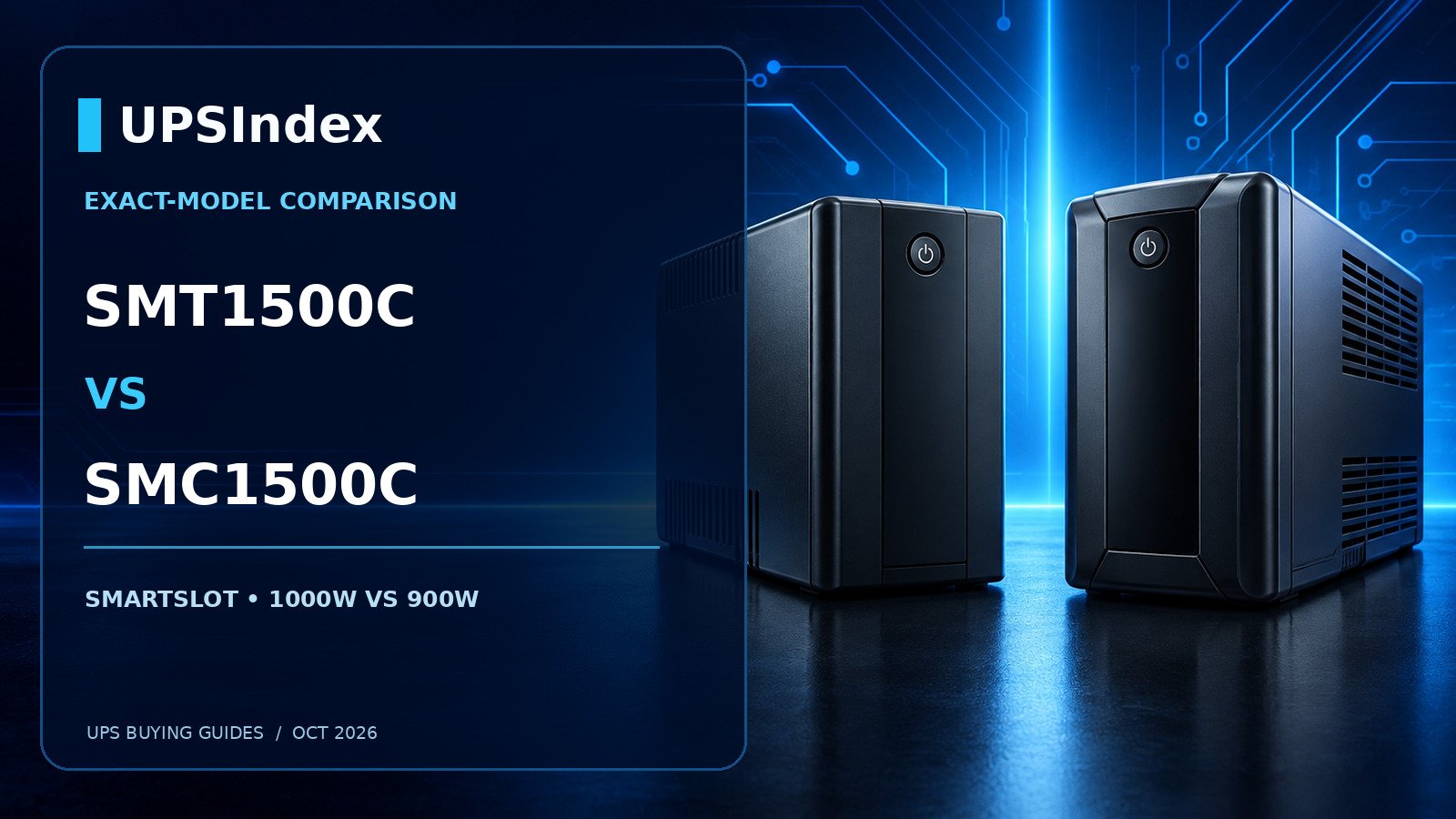
Quick answer: SMT1500C is the stronger fit when you need 1000W of rated output, a SmartSlot for an optional network-management card, or a more expandable management path. SMC1500C is a 900W Smart-UPS C tower with sine-wave output, SmartConnect monitoring and USB/serial shutdown support. Both are 1440VA line-interactive models; neither is an online double-conversion UPS.
For a server or network closet, the management interface can matter more than a small difference in watts. Choose the UPS that can communicate with the systems it protects and shut them down in the right order.
Check the exact models: SMT1500C on Amazon | SMC1500C on Amazon. Prices, stock and sellers can change; confirm the model number before ordering.
Affiliate disclosure: As an Amazon Associate, UPSIndex may earn from qualifying purchases.
At a glance: exact-model specifications
| Specification | SMT1500C | SMC1500C |
|---|---|---|
| Rated capacity | 1440VA / 1000W | 1440VA / 900W |
| Topology | Line Interactive | Line Interactive |
| Battery output waveform | Sine Wave | Sine Wave |
| Total AC outlets | 8 | 8 |
| Battery-backed outlets | 8 | 8 |
| Surge-only outlets | 0 | 0 |
| Form factor | Tower | Tower |
Capacity and outlet counts are manufacturer-model specifications, not promises of runtime or live retailer availability.
For the full database entries, see SMT1500C and SMC1500C. You can also compare both UPS models side by side using the UPSIndex comparison tool.
The ratings: 1440VA on both, but different watt ceilings
Schneider Electric specifies 1440VA/1000W for SMT1500C and 1440VA/900W for SMC1500C. The SMT therefore has 100W more rated output headroom. That can matter if you are combining a server, NAS, PoE switch and network equipment on the same UPS.
The difference does not automatically establish which has more minutes of runtime. Battery energy, efficiency and the measured load determine that. For a server that must complete backups or shut down several virtual machines, consult the manufacturer’s runtime graph and allow for battery aging.
Both have sine-wave output and eight backed-up outlets
Both are line-interactive, sine-wave tower units with AVR and eight NEMA 5-15R AC outlets. In the UPSIndex records, all eight are battery-backed. If your priority is waveform quality or total AC socket count, the two models are closely matched.
Neither can safely be loaded just by counting plugs. A server and a PoE switch may draw very different amounts of power from a printer or modem. Build a watt budget, include the PoE load, and check the UPS at normal and maximum expected operation.
SmartConnect is not the same as a SmartSlot
Both models include APC SmartConnect Ethernet monitoring for supported cloud-based visibility. SMT1500C also has a SmartSlot that can accept compatible optional management hardware. That distinction matters when a server environment requires network-based shutdown integration beyond basic cloud monitoring.
Do not assume a SmartConnect port by itself acts as a fully featured network management card or that every remote-shutdown workflow is included without additional hardware or licensing. Check APC’s current SmartConnect, PowerChute and optional-card requirements for your hypervisor, NAS and operating systems before committing.
USB or serial shutdown may be sufficient
For a single directly attached server, USB or serial communication with supported PowerChute software can be enough. SMC1500C is explicitly positioned for graceful shutdown through USB or serial. SMT1500C also supports local shutdown and offers an expansion path if the deployment grows.
If you run several hosts, containers or virtual machines, test which device owns the UPS connection and how downstream systems receive shutdown instructions. A UPS can have ample battery capacity yet still fail the operational requirement if the shutdown signal never reaches the right machine.
Maintenance, space and lifecycle
These are substantial lead-acid tower UPS units, not compact under-desk strips. UPSIndex lists approximately 53 lb for SMT1500C and 44 lb for SMC1500C; verify the manufacturer’s latest dimensional data before planning a shelf or cabinet. Provide ventilation and safe lifting access.
Schneider Electric lists replacement-battery availability for both models. Review the current cartridge, warranty, maintenance access and network-management licensing as part of total ownership cost. Manufacturer pages currently describe these models as non-stock in the distribution facility, which is not the same as confirming that every reseller is out of stock.
Which Smart-UPS is the better purchase?
Choose SMT1500C for the 1000W output limit and SmartSlot expansion path, especially where network-management options are a requirement. Choose SMC1500C when 900W is sufficient and local USB/serial shutdown plus SmartConnect monitoring covers the deployment.
A small server environment may be better served by the less complex option if its requirements are stable. An expanding homelab should make a written shutdown and management plan before paying for optional capabilities it may never use.
Common buying questions
Is SmartConnect the same as a network-management card?
No. SmartConnect provides supported cloud monitoring; optional network-management hardware and software provide additional functions that must be checked separately.
Do both deliver sine-wave output?
Yes. Both are line-interactive sine-wave Smart-UPS tower models.
Does SMT1500C provide 1500W?
No. Its rated output is 1000W; the VA rating is 1440VA.
Bottom line
SMT1500C is the more flexible platform for higher load and management expansion. SMC1500C is often the simpler answer when 900W and local shutdown cover the job. Verify the software path before buying either one.
Manufacturer references and verification
Technical ratings and model-specific features were checked against the SMT1500C manufacturer page and the SMC1500C manufacturer page. UPSIndex uses exact-model specifications; retailer stock, revisions, battery cartridge compatibility and runtimes should be rechecked before purchase. Research reviewed October 8, 2026.