
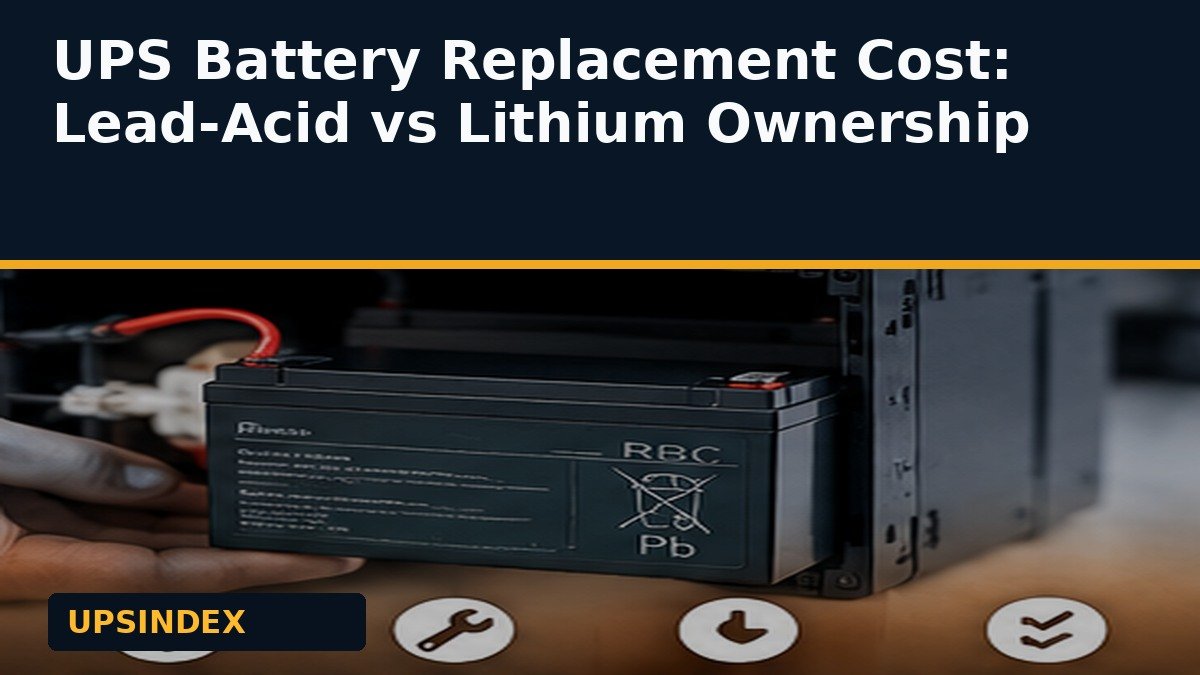
UPS Battery Replacement Cost: Lead-Acid vs Lithium Ownership
UPS battery replacement cost is part of the purchase price, even when the UPS is sold with a new battery. Many sealed lead-acid UPS batteries need attention after several years, while some lithium-ion designs are intended for a longer service interval. The correct decision depends on the exact UPS model, replacement cartridge, operating temperature and how much downtime you can tolerate.
Do not confuse battery chemistry with guaranteed service life
CyberPower describes three to five years as a common range for lead-acid UPS battery life, with heat, discharge cycles and environment affecting the result. Lithium-ion designs can have longer design lives, but they are not maintenance-free forever. The actual warranty and replacement procedure remain model-specific.
A UPS that runs hot under a desk or inside a poorly ventilated closet may age its battery faster. A lightly loaded unit in a cool, stable room can have a different service history. Plan replacement based on condition, vendor guidance and tested runtime, not just a calendar reminder.
Calculate ownership cost, not only the checkout price
Use a simple planning equation: initial UPS cost plus expected battery cartridges, installation labor, disposal or recycling, management accessories and any outage-related service cost. Compare those totals over the same ownership period for each candidate.
For illustration, suppose one UPS costs $250 and needs two $90 battery replacements during an eight-year planning period, while a second costs $420 and requires no planned cartridge replacement during that same period. Ignoring labor and other costs, both total $430. These are hypothetical numbers, not market prices or a prediction of actual battery lifespan. Your real calculation must use current exact-model quotes and a realistic service interval.
| Ownership item | Lead-acid UPS | Lithium-ion UPS |
|---|---|---|
| Initial purchase | Often lower; verify current quote | Often higher; verify current quote |
| Battery service | Replacement cartridge may be needed | Typically longer design interval; confirm service plan |
| Rack handling | Can be heavier | Some models are smaller/lighter |
| Replacement procedure | Model-specific cartridge and safety steps | Model-specific; not all packs are field-serviceable |
| Best comparison basis | Total cost over planned years | Total cost over same years |
Find the exact replacement battery before buying
Write down the full UPS model, regional variant and hardware revision. Then use the manufacturer’s replacement-battery lookup or service manual. Similar-looking UPS models can use different cartridges, connectors or quantities.
For example, the APC SMT1000RM2UC record identifies the APCRBC132 cartridge, while the CyberPower CP1500PFCRM2U record identifies RB1290X2D. These are examples of why matching the complete SKU matters; they are not interchangeable parts.
When a new battery is sensible
Battery replacement may make sense when the UPS electronics are healthy, the correct OEM-approved cartridge is available, and the replacement cost is reasonable relative to a new unit. Review warranty coverage, self-test results, runtime at a known load and the availability of qualified service.
If the UPS has other faults, repeated alarms, physical damage or an obsolete battery part, a new UPS may be safer and more economical. A swollen or leaking battery requires the manufacturer’s safety procedure and appropriate professional handling. Do not open sealed battery cases or substitute unapproved cells.
When lithium-ion earns the premium
Consider a short-depth rack, remote site or location where each service visit is costly. The APC SMTL1000RM2UC illustrates the combination of a lithium-ion battery, 2U short-depth chassis and lower listed weight. Its counterpart, SMT1000RM2UC, uses lead-acid and is deeper and heavier.
Lithium-ion does not automatically provide more minutes at a given watt load. Check each runtime chart. A home office with easy access and low replacement labor may not recover the higher initial cost, while a remote rack could.
A maintenance routine that protects the investment
Keep vents clear, maintain the manufacturer’s temperature range, record purchase and battery installation dates, and review self-test results. Check runtime at a representative load when the vendor recommends testing, and investigate unexpected drops promptly.
After replacing a battery, follow the manual for reset or calibration steps and allow proper charging before returning to critical service. Recycle spent batteries through an approved channel. The UPS comparison tool helps narrow model specifications, but it cannot replace checking cartridge cost and availability.
Bottom line
The least expensive UPS to buy may not be the least expensive to own. Compare battery service, replacement access, warranty, rack handling and runtime alongside VA and watts. For a broader starting point, the capacity guide covers electrical sizing before the maintenance decision.
Questions buyers ask
How long do UPS batteries last?
Lead-acid UPS batteries commonly need attention after roughly three to five years, but the interval varies by heat, use and manufacturer guidance.
Can I use any battery with the same voltage?
No. Follow the exact manufacturer-approved replacement cartridge and safety procedure.
Is lithium-ion always cheaper over time?
No. It depends on initial price, replacement frequency, labor and the planned ownership period.
Manufacturer and technical references
CyberPower battery lifecycle; CyberPower battery chemistry; SMTL1000 RM; SMT1000 RM. Specifications and availability can change by exact revision and region.